

Do Pet Sitters Need Certification?
What You Should Know about Pet-Sitter Certification
April 16, 2026 | Meghann Evans and Beth Stultz-Hairston, Pet Sitters International

If you’re starting or growing a pet-sitting business, you’ve likely asked yourself:
Do I need to become certified as a pet sitter?
The short answer is “no.” You can operate a pet-sitting service without being certified, but for many professional pet sitters, earning a certification is one of the most effective ways to build credibility and stand out from competitors.
In an industry where anyone can advertise services online, certification helps distinguish pet-care professionals from hobbyists and gives pet parents greater confidence when choosing a qualified pet sitter.
Continue reading to learn what pet-sitter certification is—and isn’t—and explore how becoming certified can help you and your business.
What Is Pet-Sitter Certification?
As the U.S. Bureau of Labor Statistics explains, a certification is a credential that professionals can obtain from a professional organization or non-governmental body, usually through an exam process, to demonstrate their competency for a specific job.
For pet sitters, certification can demonstrate their competence in pet care and business practices. Unlike informal training or experience alone, certification provides formal recognition of your expertise.
Is Pet-Sitter Certification Required?
Certification is not legally required to start or operate a pet-sitting or dog-walking business. The pet-care industry is largely unregulated and at this time, there is no federally-mandated licensing or other specific requirements for pet sitting.
Please note, however, that pet sitters may be subject to business license/permit requirements depending on their city, province or state. Also, pet sitting is defined as caring for a pet in the client’s home. Those who offer boarding services (pet care in their own home) may be subject to additional license/permit requirements.
Though certification is not legally required of pet sitters, that doesn’t mean it isn’t important. Certification is common and even expected in many occupations, providing employers and/or clients a way to distinguish knowledgeable workers from their peers.
Many pet sitters choose to become certified because it helps them:
- Demonstrate professionalism
- Differentiate their services
- Build trust with clients
According to a Gallup report, certifications “are associated with better employment outcomes and increased confidence in career prospects.”
Certification vs. License
Keep in mind, a certification is not the same thing as a “license.” Here’s a quick explanation of the difference:
- A certification is a voluntary credential that demonstrates knowledge and competency.
- A professional or occupational license is a government-issued credential legally required to work in some professions.
Professionals such as health care workers or commercial pilots are subject to government-mandated licensing requirements, for example, but pet sitters face no such regulations.
You may have seen some pet sitters use the word “licensed” online or on their business cards, but that can be misleading. When pet sitters say they are “licensed,” they likely mean that they obtained a business license, which is paperwork required in some jurisdictions to legally operate a business there.
Obtaining a business license is not the same as demonstrating knowledge or skills to obtain a professional license. To avoid confusion, PSI recommends that pet sitters not advertise as “licensed,” or if they do, to use language such as “Licensed to do business in [your state/province].”
Certification vs. Certificate Programs
When researching pet-care credentials online, you may see the words “certification” and “certificate” used interchangeably, but they are not the same.
According to the Institute for Credentialing Excellence:
A certificate program:
- “provides instruction and training.”
- has a goal of participants acquiring “specific knowledge, skills, and/or competencies.”
A certification program, however:
- “assesses knowledge, skills, and/or competencies previously acquired.”
- has a goal of validating a person’s competency through a formalized assessment.
A certification also typically has recertification or renewal requirements where the professional must participate in continuing education or periodic re-assessment to maintain the credential
So, while anyone can complete a course to earn a certificate, only knowledgeable professionals can pass a certification exam to validate their expertise and become “certified.”
Benefits of Pet-Sitter Certification
Now let’s explore why becoming certified is a solid investment for your pet-sitting or dog-walking career.
There are a wide range of professional and personal benefits to earning a pet-sitter certification.
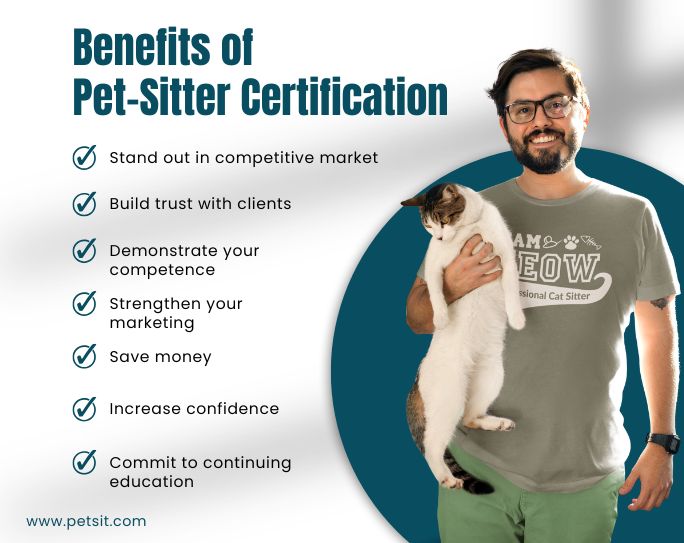
Earning a pet-sitter certification helps you:
- Stand out in a competitive market. Certification distinguishes you from hobbyists or casual pet sitters and provides you with a competitive advantage in your service area.
- Build trust with clients. Pet parents need an easily identifiable way to determine the most qualified pet sitters. They are trusting you with their pet and home, and a recognized credential helps reinforce your credibility and professionalism.
- Demonstrate your competence. It’s easy to tell pet parents that you are a knowledgeable pet sitter, but your word will carry more weight if you have a credential to back it up. Earning a certification validates that you understand best practices in pet care and business operations. You deserve to be recognized for your expertise!
- Strengthen your marketing. When you become certified, you gain an important credential you can highlight to current and potential clients, and you’ll want to include it on all your marketing materials!
- Save money. Often, certified professionals are eligible for additional perks or savings, since they have demonstrated their dedication and expertise. Click here to read about the additional savings available to PSI’s CPPS-Certified Professional Pet Sitters.
- Increase confidence. There are many perks to becoming certified, but one you may not have thought about is the personal satisfaction and confidence boost you get after proving that you possess the knowledge required to pass rigorous exam standards.
- Commit to continuing education. Certification provides you with great motivation to stay up to date on the latest best practices in business and pet care, since you’ll be required to participate in ongoing learning to maintain the credential.
How to Become a Certified Pet Sitter
While requirements may vary by program, there are some common steps involved in obtaining a certification:
- Research programs. Any pet-sitter certification should be offered by a reputable organization with clearly-defined guidelines, processes and costs. You can view the study objectives for PSI’s exam online before even registering.
- Register. You can typically do this online by paying a fee.
- Prepare for the exam. Take advantage of any materials and recommendations provided to you to refresh your knowledge.
- Take (and pass!) your exam. Some certification programs require candidates to go to a testing center to take their exam, while others offer online testing in the presence of a proctor. You can take PSI’s online CPPS Exam anywhere, as long as you’re in the presence of a proctor of your choosing (family and significant others excluded).
- Promote your certification. You should be able to download a certificate—and likely a logo and more—once you obtain a certification to highlight your credential in your marketing materials.
Once you have obtained your pet-sitter certification, you will then likely participate in continuing education over the course of your career in order to maintain it. For example, PSI CPPSs must obtain 30 continuing education units (CEUs) every three years to apply for certification renewal, and they can easily earn those through a variety of free PSI trainings and/or eligible trainings by other providers.
Continuing education requirements are a good thing! Pet sitters who are always learning are best positioned to offer cutting-edge pet care and operate successful companies.
Certification Costs and Time Commitment
As with other credentials across various industries, earning a pet-sitter certification will require you to invest some time and money.
For example, PSI’s CPPS Exam:
- Costs $275 USD (but periodic sales/discounts are available)
- Allows candidates up to 6 months to request the exam
- Requires renewal every three years ($85)
- Requires 30 continuing education units (CEUs) for renewal
Any organization offering a credential should clearly list the costs associated with it, so be sure to do your research before signing up.
PSI’s CPPS-Certified Professional Pet Sitter® Credential
When researching pet-sitter certification, it’s important to choose a credential from a reputable organization.
At Pet Sitters International (PSI) we are always happy to answer questions about our certification program for professional pet sitters.
Because PSI’s program is an actual certification (not a certificate), there is no accompanying coursework. Instead, professional pet sitters take the certification exam to demonstrate their expertise and become “certified.”
PSI’s CPPS-Certified Professional Pet Sitter® Exam is the first-ever knowledge-assessed examination specifically for the pet-sitting industry.
CPPS-Certified Professional Pet Sitter® is a federally-trademarked certification mark PSI awards to professional pet sitters who successfully pass the CPPS Exam.
PSI’s CPPS Exam is:
- A knowledge-assessed certification exam (not a course)
- Designed specifically for the pet-sitting industry
- Based on the general body of knowledge established for the pet-sitting industry
- Aligned with PSI’s Global Standards for Professional Pet-Sitting and Dog-Walking Businesses
While certificate programs have their place, PSI’s intent with the CPPS Exam is not to test you on coursework, but to evaluate whether you have the broad range of knowledge required to succeed in the pet-sitting industry.
Learn more about PSI’s CPPS designation, the exam, study objectives and more at www.petsit.com/certification.

Pet-Sitter Certification and Industry Standards
Becoming certified doesn’t just benefit you. It boosts the industry at large.
When you pursue pet-sitter certification, you:
- Reaffirm your commitment to high standards
- Raise public awareness about what it means to be a professional
- Help elevate the professionalism of the industry
In the pet-sitting industry, we often hear pet sitters talk about how pet parents should hire “true professionals,” and rightfully so. Pet sitters who are committed to following industry standards are best positioned to offer quality care.
But you should ask yourself this question: Am I actually approaching my pet-sitting career like a professional?
Serious pet-sitting professionals understand the importance of credentials and established standards of excellence in the pet-sitting industry.
In fact, PSI's Global Standards for Professional Pet-Sitting and Dog Walking Businesses—released last year—inform the general body of knowledge that pet sitters are tested on to obtain the CPPS designation.
In the internet age, anyone can post services online and call themselves a “pet sitter,” but there is so much more to the job than simply “loving pets.”
When you show pet parents that pet sitting is a real career with real credentials, you benefit not only yourself, but the entire pet-sitting industry.
How to Use Certification to Grow Your Business
You may wonder if clients will even care if you earn your certification, and the answer is yes, IF you educate them and explain what’s in it for them.
Once you obtain pet-sitter certification, you should highlight it in every way you can, such as:
- Posting about it on social media.
- Adding the logo (with permission) or a picture of your certificate to your company website.
- Sending a press release to local news outlets.
- Announcing it to clients in your next newsletter.
- Including the credential on your business card.
- Adding the credential to the signature of your business emails.
- Including your credentials in any of your online listings (Google Business Profile, PSI Locator, etc.).
We hear from CPPSs every month who say that once they explain to clients what certification entails and how they are committed to continuing education and a high level of care, the pet parents are very impressed. It’s the kind of thing clients like to talk about to other pet parents. And that provides a real marketing advantage!
Is Pet-Sitter Certification Worth It?
Are you knowledgeable about professional pet sitting? If the answer is “yes,” then certification is the next logical step in your pet-sitting career!
Certification provides:
- Professional recognition
- Increased credibility
- Additional discounts and savings
- Marketing advantages
- And more
Most importantly, it signals to clients that you take your profession seriously and are committed to providing the highest level of care.
Certification is not just an item to check off your to-do list. It demonstrates your willingness to devote time and effort to staying at the top of your field, and your willingness to provide clients and their pets with the best possible service.
Take the Next Step in Your Pet-Sitting Career
If you’re ready to stand out as a professional and grow your pet-sitting business, becoming certified can be a significant next step.
Pet Sitters International offers continuing education, community and credentials professional pet sitters and dog walkers need to succeed.
Learn more about starting and growing a professional pet-sitting business with PSI:
Learn more about PSI’s CPPS-Certified Professional Pet Sitter® Exam:
If you’re not a PSI member, we invite you to join our community of professional pet sitters who are raising the standards of pet care.

Comments
รับทำ seeding