


Setting and raising your pet-sitting rates
Pet Sitters International | Updated July 2026

"What should I charge?" is one of the most common questions PSI receives—and deciding upon your rates is a significant business decision that involves many factors.
Why can't I ask what other pet sitters charge in PSI's Facebook group?
It can be difficult to find information on the topic of pricing, so we understand why PSI members want to ask for advice on how much to charge for specific services or ask fellow PSI members what their specific rates are.
And often members get upset when they realize that discussing specific rates is against the group rules for Professional Pet Sitters Chat, PSI's private, members-only Facebook group.
But, it's for good reason! Service providers (including pet sitters and dog walkers) are prohibited from collectively discussing specific pricing details in group settings or in online groups because of anti-price fixing laws. We wish you could openly discuss rates in our group (we know you want to!), but to protect our association and members (and because we are committed to professional, ethical business practices), we follow the law.
We consult with legal counsel regularly to see if these rules have changed and if there are ways to permit these conversations, but have consistently been advised that adhering to these anti-price fixing laws is particularly important for online groups, where price fixing could unintentionally, but easily occur.
So, while you may see these discussions (listing specific rates) in other groups, please understand that PSI is simply following the laws and protecting our members.
That doesn't mean we can't discuss the topic of rates—both setting and raising rates (we just don't mention specific amounts).
The links below will take you to some recent discussion threads about rates in Professional Pet Sitters Chat. You will need to be a member of Professional Pet Sitters Chat and logged in to Facebook to view the posts:
- Client's response to raising rates
- Do I need to send a message about my rate increase?
- Examples of rate-increase notifications
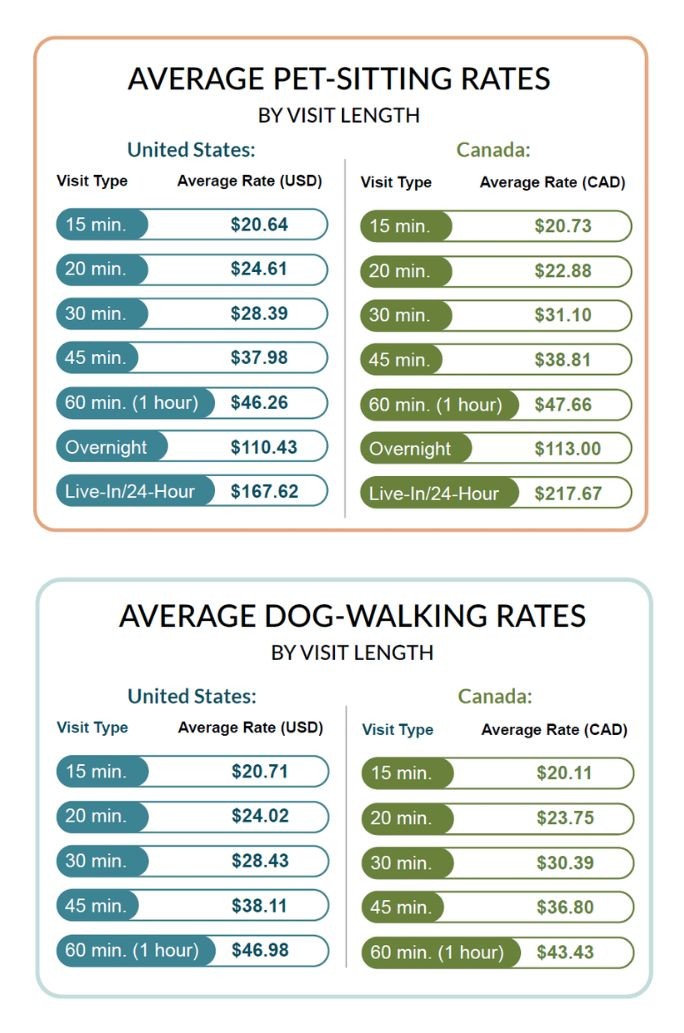
We can discuss pricing best practices and averages for the pet-sitting industry!
Pricing can be discussed in general terms and industry averages, and this data can help guide you as you make pricing decisions for your business.
PSI’s State of the Industry Survey includes questions on rates and services, and we are able to share that information with you.
PSI surveys its member businesses every two years on topics including pet-sitter demographics, rates, income, business size and types of services provided. The survey results are used to develop an accurate PSI member profile and to examine industry trends.
The information provided below is from PSI’s 2026 State of the Industry Survey.
Beyond the averages…
Because the rates highlighted above are averages, typical rates may vary dramatically depending upon where you live. Because of this, it is also a good idea to take a look at what other professional pet sitters, boarding facilities and doggie daycares in your area charge in order to get an idea of local pricing.
As a general rule, boarding facilities and daycares may be slightly less expensive for one dog (when compared to the cost of 3-4 daily pet-sitting visits), but are often significantly more expensive for multiple pets—as many professional pet sitters charge by time, instead of a flat, per-pet fee.
When comparing rates of other pet sitters in your area, be sure to differentiate between professional pet-sitting businesses and hobbyists. As a professional pet sitter, your pricing should be in line with other professionals who maintain pet-sitter insurance, obtain appropriate business licenses when necessary, etc. Non-professional sitters will be able to offer unrealistically low rates because they do not have the same overhead costs for professional credentials, so they do not provide an accurate comparison.
Remember this professional courtesy! Because most pet sitters have business websites, you will likely find it easy to locate the rates of local pet-sitting businesses online. However, if you find that you will need to contact a pet sitter directly to inquire about rates during your research, be honest.
You should never pose as a potential client when gathering this information. As a professional courtesy, you should be upfront and explain that you are starting a new professional pet-sitting business. This initial contact could lead to a great networking opportunity!
Other considerations:
In addition to the going rates in your local market, there are other factors you should consider. Remember, when setting fees, you’ll want to do some calculations to anticipate what your overhead business costs will be.
The expenses include insurance and bonding, software (if applicable) travel expenses, phone bill, advertising, continuing education and professional membership fees, etc.
If you use staff (or have plans to use staff sitters in the near future), you should also consider the associated costs and ensure that your rates allow you to compensate staff sitters while still maintaining a profit for you and your business.
“You have to remember all the expenses that go into the professional pet-care services you’re providing, and you have to believe that you’re worth it. Be ready to explain to surprised customers that there is more to this business than simply putting out some pet food. Once customers understand the value of your services, price is usually not a deterrent.”
– PSI Founder and CEO Patti Moran
In order to meet these expenses, you will need to factor a flat overhead cost and a margin of profit into each service fee.
Do you need to raise your pet-sitting rates?
There are various reasons that may prompt (or force) you to raise your rates.
Oftentimes new pet sitters find that they set their rates too low initially, are priced well below other professionals in their service area and can’t maintain a profitable business at their current rates.
Even for pet sitters who use the “formula” outlined above to set their rates when they started pet sitting, a rate increase will eventually be needed (and likely many times throughout your pet-sitting career). As with any other industry, business and economic changes necessitate regularly reviewing your rates to ensure your fees remain competitive but also allow you to continue to operate a professional and profitable pet-sitting service.
Your reason for increasing your rates may be the increased cost of doing business—business license, insurance, bonding and certification fees or even travel expenses due to the rising cost of gasoline. Or, it may be that you’ve changed your business model and need to update your rates now that you use staff sitters. Some professional pet-sitting business owners even decide to raise their rates to appeal to a specific type of clientele.
In the current economy, businesses (in many industries) have had to re-evaluate their fees and adjust their pricing structures due to rising costs of supplies and resources, the need to increase pay to attract staff and a variety of other factors. So, if you are raising your rates, you are not alone—and your clients will likely not be surprised at all!
Keep in mind that even a small rate increase can have an extremely positive effect on your bottom line.
Here's an example: According to PSI’s 2026 State of the Industry Survey, on average in 2025, PSI pet sitters in the U.S. served 113 households and completed 4,200 visits. Using this number of visits as an example, a $2 rate increase would likely be insignificant to your clients, but your pet-sitting revenues would increase by $8,400 in one year!
How should you notify your clients about your rate increase?
Whatever your reason(s) for increasing your rates may be, it can still feel like a daunting task to notify your pet-sitting clients. So, how do you go about increasing your rates?
First things first—once you’ve decided on your rate increase, update any information you have publicly available—your fee schedule on your company’s website, the fee information in your pet-sitting software program if you use software, any fee information you may have included in your listing on PSI’s Pet Sitter Locator, etc.
This way, any potential new clients only see your current rates and you don’t have to explain any discrepancy if they call to inquire about service and you quote rates different from what you’ve listed online.
Next, you you'll need to decide when and how you will notify your current clients.
When and how you notify your current clients will depend on a few different factors, including:
- When you plan to begin charging them the new rate(s): Is the increase effectively immediately, will current clients be grandfathered in at their previous rates, or do you plan to give current clients a 30, 60, or 90-day notice, for example? As a business owner, you can choose the option that works best for you, but you must notify clients of your new rates before (or when) they book an assignment. You can’t surprise them with a larger-than-expected pet-sitting bill after the visit!
- How often the clients use your services: Daily dog-walking clients would be impacted more immediately than clients who use your service for vacation visits once or twice per year (and could be notified at the time of their next pet-sitting request).
- How you typically communicate with clients: If your communications with current clients is exclusively online or through email/text, a written rate increase letter may not be necessary. But, if you mail invoices, leave written notes behind, etc. as a regular rule, mailing or leaving the rate increase letter with their invoice as the conclusion of a pet-sitting visit may be a better option.
When notifying clients by email, mail or with a leave-behind, you can also include the notice as part of a larger newsletter instead of a stand-alone piece if you are more comfortable with that approach. Depending on the timing of your rate increase, you could share a spring newsletter that shares the increase notice, includes a reminder to book summer visits early and also includes seasonal pet-safety tips and an upcoming calendar of pet-related events in your city.
The choice is yours! While many pet sitters choose to make a more official announcement/notification to clients, others say they simply give them the new rates the next time a client books services.
Whatever method and timeline you choose for notifying your clients, a pet-sitting best practice is to keep your rate-increase notification professional and very simple. You should not apologize and you do not have to offer specific reasons.
Here’s an example of a very simple notification:
Effective September 1, 2026, ABC Pet Sitting’s rates for our standard 30-minute pet-sitting visits will be $30 per visit and $35 for daily dog walks.
We are committed to providing the best pet-care services in Winston-Salem, and are happy to have your pets as part of the ABC Pet Sitting family.
Thank you for entrusting ABC Pet Sitting with your pets’ care!
Your Name
ABC Pet Sitting
Some pet sitters feel more comfortable providing at least some type of explanation, and the notification above can be edited slightly to do that:
Thank you for entrusting ABC Pet Sitting with your pets’ care!
Due to the rising costs of doing business, we will be raising rates slightly to ensure we can continue to offer the best service possible. Effective September 1, 2026, ABC Pet Sitting’s rates for 30-minute pet-sitting visits will be $30 per visit and $35 for daily dog walks.
We are committed to providing the best pet-care services in Winston-Salem, and are happy to have your pets as part of the ABC Pet Sitting family.
Your Name
ABC Pet Sitting
A word of caution: If you do want to provide specific reasons for your rate increase, be careful about citing the cost of gas as a reason. Because gasoline rates fluctuate, your clients may expect your rates to decrease when the cost of gasoline goes down (if you’ve used that as your reason for a rate increase). Remember, less is typically best when it comes to communicating price increases. Consider other service providers you use. It’s likely that they provide no specific details when their prices increase—and as a client, you understand that increases are a part of business. Your clients will understand as well!
Don’t be scared to raise your rates!
A common fear we hear from pet sitters is “what if I raise my rates and lose current clients?!” Some people simply don’t like change—or are extremely frugal—so it’s possible that some clients may contact you to ask why you are raising your rates or complain. Don’t take this personally.
Remember, you are a professional business owner and increasing rates from time to time is necessary in every profession. Even if a few clients question your decision, simply reiterate that as a professional pet sitter, you want to ensure that you can always provide the best service and continue to offer pet-sitting services for years to come. You may want to remind these clients of the benefits your service offers, but don’t feel the need to justify your business decision or feel pressured to discount their rate.
What pet sitters often find is that most clients don’t comment at all, or those who do simply say, “well, it’s about time!” You’ve established a relationship with your current clients and their pets. The peace of mind you provide is well worth a slight rate increase, and clients who value your services will have no problem with it.
Share your feedback below in the comments section.
Have you raised your pet-sitting rates since you started your pet-sitting business? How did you notify clients, and how did they respond?


Comments
Nancy Johnson
The pricing information you and the members provided have helped me shape my fees which, I believe, can still move upward in the future, if I am so inclined.
I am curious, however, how your members handle payments? Do they require a deposit or payment up front? Do they bill at the end of the job? I find if I wait until the end of the job, I forget who has paid and who hasn't yet I am uncomfortable asking new clients, who don't know me well, to pay prior to a sit.
I paid for a pet billing/scheduling program but feel it is too complex for my needs. I am going to try to familiarize myself without until the end of the year to see if it adds benefit or if I should just insist on payment up front.
I am a solo, specialize in overnight vacation pet sits and do not rely upon the income to pay my living expenses. I am fortunate to be retired from an occupation that allowed me to save. Therefore, I do not need to price my services on the high end of the scale yet I don't want to lose money, either. Any advice or direction you could offer would be greatly appreciated.
Regards,
Nancy Johnson
cattitudesatlatitudes@gmail.com
732 513 1832
Lauren
Sandra L.
Rose Connolly
go up and with gas at 4.00 a gallon
in Calif. it is what it is...
LUIS ROSA
Crissy Doucette
Tisha
Susan Villella
Sherry Esther
Laura Hoyt-Staley